

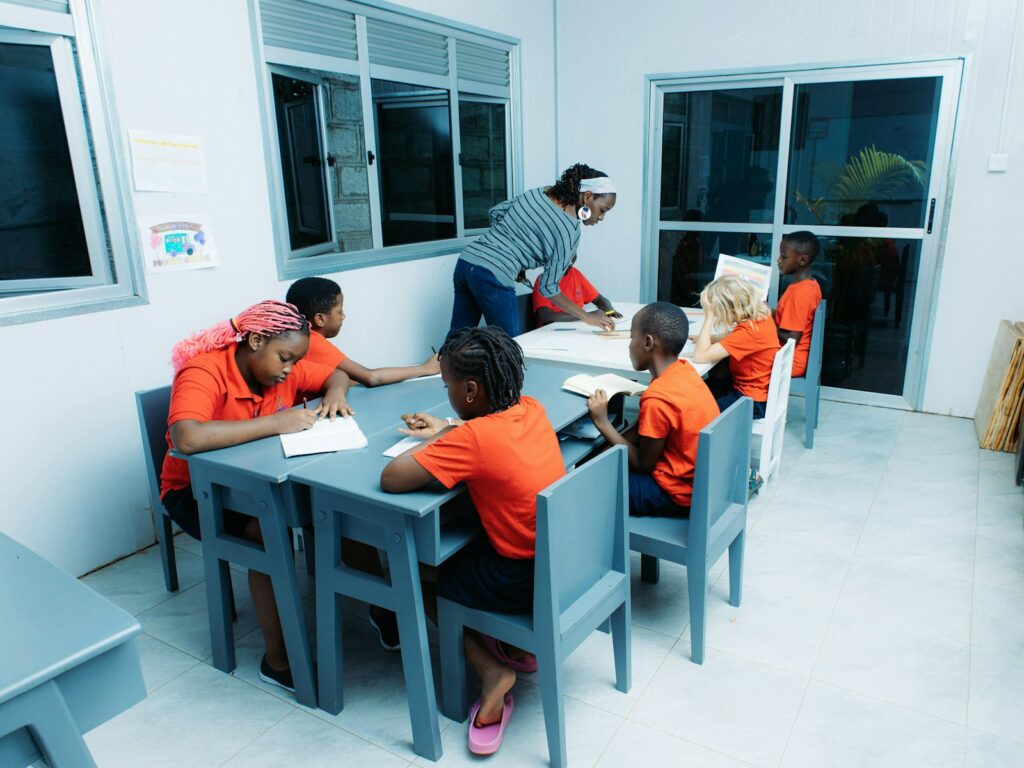
Jigsaw reading is a classroom technique in which a text is divided into parts, each learner reads only one part, and the group then reconstructs the whole by telling each other what they read. It is an information gap exercise: the reading creates the gap and the speaking closes it.
The short version
- Split the text, not the class. Each learner reads one part and nobody reads the whole thing first.
- The information gap is what does the work. If a learner can finish the task without listening to anyone, it is not a jigsaw.
- Set a task that spans the whole text, so the parts have to be combined rather than simply reported.
- It is reading into speaking. Expect summarising, not reading aloud, and give lower levels the language to do it.
Part of the TEFL teaching methods and classroom techniques glossary
Where the technique comes from
The jigsaw was not invented for language teaching. Elliot Aronson and his graduate students built it in Austin, Texas, in 1971, after the city desegregated its schools and the classrooms that resulted were producing fist fights rather than friendships. Aronson’s team concluded, in their own words, that inter-group hostility was being fueled by the competitive environment of the classroom
, and designed a structure that made pupils depend on one another instead.
The original method divides a unit into sections, gives each member of a group one section, sends learners with the same section off to an expert group to prepare it, and then returns them to teach it to their own group. Nobody can pass the test on their own, because the only route to the other sections is through the people who read them.
Language teaching borrowed the structure and applied it to a text. The British Council’s teaching knowledge database puts the adapted version plainly: A jigsaw listening or reading activity is an information gap exercise.
That sentence is the whole technique. Everything else is logistics.
What makes it a jigsaw and not just group work
This is where most classroom versions of the activity go wrong, and it is worth being exact about.
| A jigsaw reading | Reading in groups | |
|---|---|---|
| What each learner has | One part of the text, and only that part. | The whole text, read together or in turn. |
| Why learners talk | Because the information they need is held by someone else. | Because the teacher asked them to. |
| The task | Cannot be completed from one section alone. | Could be completed alone, more slowly. |
| Skill shape | Reading into speaking into listening, integrated. | Reading, with discussion attached afterwards. |
| What failure looks like | A learner who did not listen cannot answer. | A quiet learner who copies the answers and is never found out. |
The test is a single question, and it is worth asking of any activity before the photocopying starts: could a learner complete this task without listening to anybody. If the answer is yes, the speaking is decoration.
How it is run in practice
- Pick a text that divides cleanly. Parallel structures work best: three cities, four opinions, five stages of a process. A tightly argued article that builds from paragraph to paragraph does not cut into independent pieces and should be left alone.
- Cut it, and hand out one part per learner. Two parts is the standard pair version. Three or four parts needs groups and more time. Label the parts, because you will need to regroup by label in a minute.
- Set the task before the reading, not after. Learners read with a purpose only if they know what they are reading for, and the purpose has to need the other sections. Ordering events, completing a table with one column per section and filling a gap in a timeline all work.
- Let them read alone and in silence. This stage is individual. Allow notes but not full sentences copied out, because the point of the next stage is to say it rather than to read it back.
- Regroup so that every part is represented once. With three sections, make groups of three, one A, one B, one C. The optional expert stage goes between: all the As meet first to agree what their section says, which lifts the weaker readers before they have to report.
- Have them report, then complete the task together. Texts face down if you want the summarising to be real. The teacher circulates and listens rather than explaining.
- Check as a class and give the whole text out at the end. Learners want to see what they missed, and the full text becomes homework or a later reading comprehension.
A worked classroom example
A B1 class of fifteen adults in Galway, a lesson on city transport. The text is a short article with three sections: a cycling scheme in Seville, a tram network in Bordeaux and a congestion charge in Stockholm. The task is a four-column table the class fills in together, with a final row that asks which city solved the most for the least money, which no single section answers.
Reading, eight minutes. Learners are As, Bs and Cs. Each reads one city, alone, and notes three facts: what was introduced, when, and what changed afterwards.
Expert groups, five minutes. All the As together, all the Bs, all the Cs. They compare notes and agree the three facts. A learner who misread a figure is corrected here, by a peer, before it reaches anyone who cannot check it.
Jigsaw groups, twelve minutes. New groups of three, one of each letter, texts face down. Each reports their city while the others fill in the table. The last row forces a comparison, so the group has to argue.
Feedback, five minutes. The table goes on the board, the class resolves the disagreements, and the full article is handed out.
The way this activity usually fails
The teacher photocopies the article whole and asks pairs to take half each. Within a minute everyone has read everything, because the other half is sitting on the desk in front of them. The exchange that follows is a formality, learners say almost nothing, and the lesson looks like a jigsaw that did not work. It worked exactly as designed: the gap was never created. Cutting the paper is not an administrative detail, it is the activity.
Commonly confused with
| Term | Often confused with | The distinction |
|---|---|---|
| Jigsaw reading | Group reading | Group reading gives everyone the same text. A jigsaw gives each learner a different part and withholds the rest, which is what obliges them to speak. |
| Jigsaw reading | Information gap | Information gap is the general principle, covering describe and draw, find the differences and a hundred speaking tasks. Jigsaw reading is one application of it, with a text as the source of the gap. |
| Jigsaw reading | The jigsaw classroom | The jigsaw classroom is Aronson’s full cooperative learning structure, including the expert groups and the individual assessment at the end. Jigsaw reading is the text-based version language teachers use, often without the assessment. |
| Expert group | Jigsaw group | The expert group holds learners with the same section, preparing together. The jigsaw group holds one learner from each section, reporting to each other. Mixing the two up is the most common setup error. |
| Jigsaw reading | Running dictation | Both move text around a room. A running dictation asks learners to reproduce wording exactly, so it is accuracy work. A jigsaw asks them to convey meaning in their own words, so it is closer to fluency work. |
| Jigsaw reading | Jigsaw listening | The same structure with recordings instead of texts. The British Council notes it is harder to manage, needing separate playback for each group, space so groups do not disturb each other, and more time. |
What the evidence actually supports
Cooperative reading structures generally beat whole-class instruction. Pan and Wu’s study of seventy-eight EFL freshmen found statistically significant differences in favour of cooperative learning on reading comprehension, with the effect strongest among medium and low proficiency students, and a positive effect on motivation as well.
Jigsaw specifically has repeatedly shown gains, in small studies. Katemba and Samuel’s experiment with two grade eight classes in Bandung reported a significant difference in reading comprehension in favour of the jigsaw group. Shaaban’s earlier work with grade five EFL learners in Lebanon tested a jigsaw model against whole class instruction on comprehension, vocabulary and motivation to read.
The caveats are real and worth stating. Most of this literature consists of short classroom experiments with one or two intact classes, a few weeks of treatment and no follow up, which is enough to show a difference and not enough to size it. Comparisons are usually against conventional instruction rather than against another well designed group activity, so part of what is measured may be novelty and attention rather than the jigsaw structure itself.
What is not established. Whether the gain comes from the information gap, from the rehearsal in the expert group, from the obligation to explain, or simply from reading less text more carefully. Those four mechanisms are rarely separated, and a teacher deciding how to run the activity would benefit from knowing which one matters most.
In the classroom
Three things that decide whether this works.
- Cut the text physically. Separate pieces of paper, one per learner. Everything else in the activity depends on this and it is the step most often skipped.
- Use the expert stage with weaker classes. Five minutes agreeing the content with peers who read the same section removes most of the fear of reporting.
- Make the final question need all the parts. A task that can be answered section by section lets learners stop listening once their own turn is over.
Sources and further reading
The five linked sources below were opened and checked on 28 October 2026. The remaining items are books and a journal article with no freely readable edition to link to, so they are cited bibliographically rather than linked.
| Source | What it provides |
|---|---|
| British Council, Jigsaw, Teaching Knowledge Database | The definition used here, including the statement that a jigsaw listening or reading activity is an information gap exercise, and the note on why jigsaw listening is harder to manage. |
| British Council, Jigsaw reading | A stage by stage classroom procedure for the two-part pair version, including how to model the search for key ideas before learners read. |
| The Jigsaw Classroom, History | Aronson’s own account of the 1971 Austin origin, the desegregation context and the conclusion about competition that the technique was built to answer. |
| Pan, C. and Wu, H. (2013), The Cooperative Learning Effects on English Reading Comprehension and Learning Motivation of EFL Freshmen, English Language Teaching 6(5), 13 to 27 | Evidence for cooperative reading structures over whole class instruction, with the effect concentrated among medium and low proficiency learners. |
| Katemba, C. V. and Samuel (2017), Improving Students’ Reading Comprehension Ability Using Jigsaw 1 Technique, Acuity 2(2) | A controlled classroom experiment on the jigsaw specifically, with sixty-five grade eight learners in Bandung, Indonesia. |
| Shaaban, K. (2006), An Investigation of the Effects of Cooperative Learning on Reading Comprehension, Vocabulary Acquisition and Motivation to Read, Reading Psychology 27 | An earlier jigsaw study with forty-four grade five EFL learners in Lebanon, covering comprehension, vocabulary and reading motivation together. |
| Harmer, J. (2015), The Practice of English Language Teaching, fifth edition, Pearson | The standard teacher training treatment of jigsaw tasks within integrated skills work and receptive skills lesson design. |
| Ur, P. (2012), A Course in Language Teaching, second edition, Cambridge University Press | Group work management, including how to set up and monitor activities where the teacher cannot hear every group. |
Frequently asked questions
What is jigsaw reading?
Jigsaw reading is a reading and speaking activity in which a text is split into sections, each learner or group reads only one section, and the learners then pool what they read to rebuild the whole text or answer questions none of them could answer alone. The British Council describes a jigsaw listening or reading activity as an information gap exercise, and that gap is the point of it.
How do you set up a jigsaw reading activity?
Choose a text that divides cleanly, cut it into two or more parts, and give each learner one part only. Set a task that cannot be completed from one part, such as ordering events or answering questions that span the whole text. Let learners read alone, then put them in groups where every part is represented and have them report to each other. Check the answer as a class afterwards.
What is the difference between jigsaw reading and reading in groups?
The information gap. In a jigsaw, each learner holds something the others need and cannot see, so talking is the only route to the answer. If everyone has the whole text in front of them, the speaking becomes optional and the activity collapses into reading with a discussion attached. The simplest test is whether a learner could finish the task without listening to anyone.
Where does the jigsaw technique come from?
Elliot Aronson and his graduate students invented the jigsaw classroom in Austin, Texas, in 1971, as a response to racial conflict in newly desegregated schools. Their conclusion was that inter-group hostility was being fuelled by the competitive environment of the classroom, so they built a structure in which each pupil held a piece the others needed. Language teaching borrowed the structure and applied it to texts.
What level is jigsaw reading suitable for?
It works from A2 upwards, provided the sections are short and the task is clear. The limiting factor is not reading level but the speaking demand, because learners have to summarise rather than read aloud. With lower levels, keep the sections to a few sentences, allow notes, and give the language needed to report, such as a frame for saying what happened first.
Can jigsaw reading be used for listening?
Yes, and the structure is identical: different groups hear different recordings and then combine what they heard. The British Council notes that managing a jigsaw listening exercise is more challenging because it needs separate playback, enough space for groups not to disturb each other, and more time. Most teachers meet the technique first through reading for that reason.
Related terms in this glossary
- Task-based learning, the approach a jigsaw sits most naturally inside, where the task comes first and the language focus follows from it.
- Concept checking questions, the technique for confirming that learners understood the instructions before a jigsaw starts, which is where this activity most often falls over.
- Guided discovery, the other main way of making learners do the work of arriving at the content rather than receiving it.
- The full TEFL teaching methods and classroom techniques glossary.
For the qualification and career terminology behind classroom practice, see TEFL qualifications and terminology explained on The TEFL Institute. For what Irish employers ask for and how much practical teaching a course covers, see 120 hour versus Level 5 TEFL on The TEFL Institute of Ireland.
How to cite this definition
tefl.ai (2026) Jigsaw Reading. TEFL Teaching Methods and Classroom Techniques Glossary. Available at: https://tefl.ai/jigsaw-reading/ (Accessed: 28 October 2026).
Last updated 28 October 2026. Written by Katie Troy for tefl.ai. All linked external sources were opened and checked on that date.