Teachers check for AI in four ways, and only one of them involves a detector. Most start with what they already know about the student’s usual work, then look at process evidence such as drafts and version history, then talk to the student. A detector score, where one is used at all, comes last and proves nothing on its own.
Key takeaways
- Familiarity with a student’s previous work is the most reliable signal any teacher has, and no tool replaces it.
- Process evidence, meaning outlines, drafts and document version history, is stronger than any detector output.
- A short conversation about how the student approached the task resolves most cases in either direction.
- Detector scores are probabilities shaped by how predictable the writing is, not findings about who wrote it.
- In English language teaching the detector step is the least trustworthy, because learner writing naturally scores as machine-like.
1. The familiarity check
This is what teachers actually do first, usually without calling it a method. You have months of that learner’s writing and you have heard them speak every week. A submission that suddenly uses vocabulary well beyond their active range, or shifts register, or deploys structures you have never seen them attempt, stands out before any tool is opened.
The reverse matters just as much. If a flagged essay reads exactly like everything else that student has produced, that is strong evidence it is theirs, whatever a percentage says.
The limitation is obvious: it only works with students you know. For a first assignment, a large cohort or a new class, you have no baseline, which is why the next step exists.

2. Process evidence
The strongest check available, and the one most teachers underuse.
Ask for the work in stages: an outline, a first draft, then the final piece. Writing that develops visibly over time, with false starts and revisions, is difficult to fake convincingly. Shared documents make this easier still, because version history shows text appearing gradually rather than arriving in a single paste.
A student who submits a polished essay with no outline, no draft and no editing history has a question to answer that no detector score raises as cleanly. And unlike a percentage, process evidence is something you can show a student, a parent or a committee without arguing about statistics.
3. The conversation
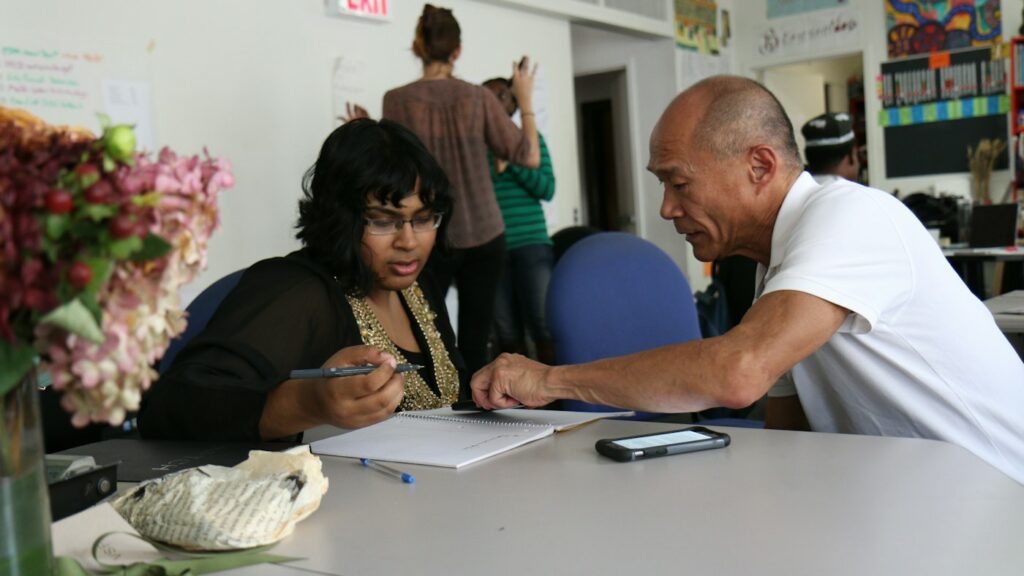
Two minutes, asked with curiosity rather than suspicion. Why did you structure it that way? What did you find hardest? Where did this example come from? Tell me more about this paragraph.
A student who wrote the piece can talk about it. A student who generated it usually cannot discuss choices they never made. Crucially this cuts both ways: it gives an honest learner a way to demonstrate authorship rather than being asked to disprove a number, which is a far fairer position to put them in.
4. The detector, last and lightly
Where an institution provides one, it usually runs automatically, so the question is less whether to use it than what weight to give the result.
The answer is very little on its own. Detectors measure how predictable writing is, not who produced it. Reporting in Nature puts GPTZero’s false-positive rate on genuinely human writing at an estimated 16%. In English language teaching the problem is far more severe: peer-reviewed research in Patterns found seven detectors wrongly flagged an average of 61.22% of human-written TOEFL essays by non-native speakers, against 5.19% for native-speaker essays.
So a flag on an ESL submission is barely informative. Use it as a prompt to look at drafts and talk to the student, which is where you were headed anyway.
The order that works
| Check | What it tells you | Limitation |
|---|---|---|
| Familiarity with past work | Whether the piece matches the learner’s known range | Needs a history with that student |
| Drafts and version history | Whether writing happened over time | Has to be built into the task from the start |
| Conversation with the student | Whether they can explain their own choices | Takes time, and needs careful framing |
| Detector score | How predictable the text is | Unreliable, and worst on the students you teach |
What good practice looks like
Set up the checks before you need them. One unaided in-class writing task early in a course gives you a baseline for everyone, including students you have just met. Build drafting stages into assignments as a matter of course rather than introducing them when you are suspicious. Design at least some tasks around a class discussion or text specific to your group, which makes generation harder and your job easier.
Done that way, checking for AI stops being a separate activity and becomes a by-product of how you assess. That is a better use of your time than policing, and it keeps working as the technology changes.
For the full picture on where detection fits, see our guide to AI detectors for teachers.
Read next
See the pillar guide to AI detectors for teachers, why detectors flag non-native English speakers, and what AI detector teachers actually use.
Frequently asked questions
How do teachers check for AI in student work?
Most compare the submission against the student’s previous work, look for process evidence such as drafts and version history, and then talk to the student about how they approached it. A detector score, where one is available, is the weakest of the four and proves nothing alone.
Can teachers tell if you used ChatGPT?
Often, but not from a tool. Teachers notice vocabulary beyond a student’s usual range, a shift in register, generic examples, or an absence of the errors that student normally makes. Those judgements come from knowing the learner, not from software.
Do all teachers use AI detectors?
No. Many never run one, particularly in private language schools where no institutional tool is provided. In universities a detector often runs automatically on submission, so the teacher sees a score whether or not they wanted one.
What is the strongest evidence a teacher can have?
Process evidence. Outlines, drafts and document version history show writing developing over time, which is hard to fabricate and easy to explain to a student or a committee. Unlike a percentage, it does not require anyone to argue about statistics.
What happens if a teacher wrongly suspects AI use?
It can be serious, especially for language learners, where a false accusation can affect a course place or a visa. This is why detector scores should never trigger an allegation on their own, and why a conversation giving the student a chance to demonstrate authorship matters.
How can students show they wrote something themselves?
Keep drafts, work in a document with version history, and be ready to explain the choices behind the piece. Being able to discuss why a paragraph is structured a certain way is usually more convincing than any tool result.
Quick favour: how do you actually use AI in your teaching?
We are running the first real study of AI use among TEFL teachers. 12 questions, about 3 minutes, fully anonymous. Leave your email at the end and you will get the report before anyone else.